

Introduction: A New Eye on the Universe
Since its launch, the James Webb Space Telescope (JWST) has lived up to its title as the most powerful space observatory ever built. Positioned nearly a million miles from Earth, JWST is revolutionizing astronomy with images and data that were once thought impossible. From unveiling ancient galaxies to peeking into exoplanet atmospheres, the telescope has opened an era of discovery that’s redefining our cosmic perspective.
In this article, we’ll explore the most recent updates, groundbreaking findings, and what the James Webb Telescope means for the future of space exploration.
What Is the James Webb Space Telescope?
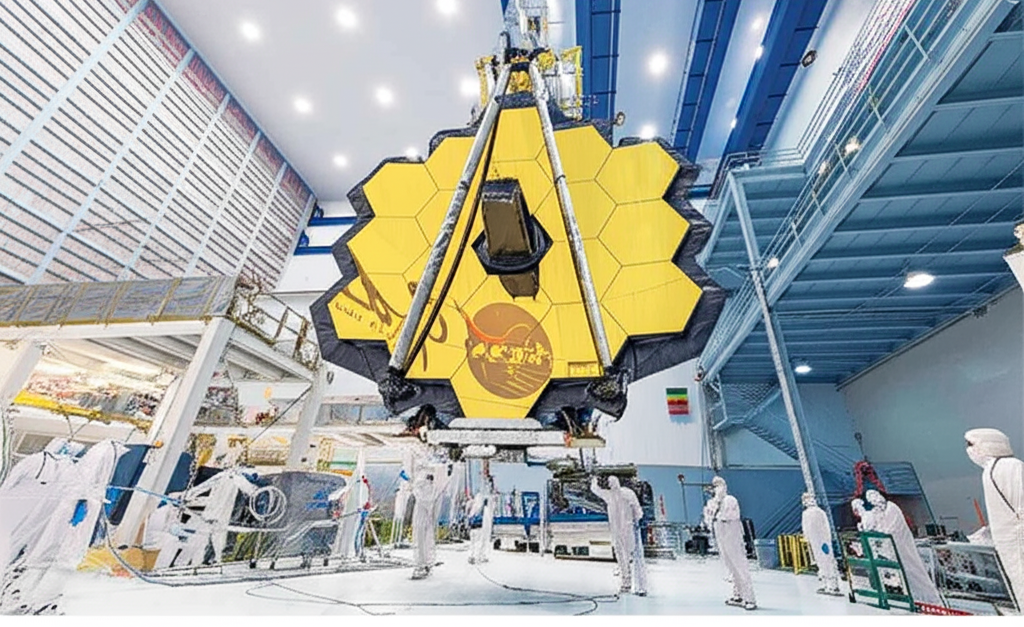
Launched on December 25, 2021, JWST is NASA’s flagship infrared space telescope, developed in collaboration with ESA and CSA. It’s the official successor to the Hubble Space Telescope but offers far superior resolution, light-collecting power, and infrared capabilities.
Key Features:
-
Primary Mirror: 6.5 meters wide (nearly three times Hubble’s)
-
Location: L2 Lagrange point (~1.5 million km from Earth)
-
Main Instruments: NIRCam, NIRSpec, MIRI, and FGS/NIRISS
-
Mission Goals:
-
Observe the earliest galaxies
-
Study star and planet formation
-
Analyze atmospheres of exoplanets
-
Explore the origins of life
-
Latest James Webb Telescope News and Discoveries (2025 Update)
JWST continues to deliver stunning and transformative results. Here are the top recent highlights:
1. Oldest Galaxy Ever Observed
In early 2025, JWST detected a galaxy—designated JADES-GS-z13-0—believed to be over 13.6 billion years old, just 300 million years after the Big Bang. This challenges existing models of galaxy formation and forces scientists to rethink how quickly the early universe evolved.
2. Detecting Carbon Dioxide on an Exoplanet
JWST has made the first definitive detection of CO₂ in the atmosphere of WASP-39b, a gas giant 700 light-years away. This is a critical step toward identifying potentially habitable worlds and studying chemical signatures of life.
3. Stellar Nurseries in High Definition
The telescope’s infrared imaging of the Pillars of Creation in the Eagle Nebula provided the most detailed views ever recorded. It revealed how stars are born within clouds of gas and dust—insights that were impossible with earlier telescopes.
4. Supermassive Black Holes in Infant Galaxies
JWST also uncovered evidence of supermassive black holes in extremely young galaxies, raising questions about how such massive entities could form so quickly after the Big Bang.
Why JWST Matters: Beyond the Headlines
The James Webb Telescope is not just about pretty pictures—it’s rewriting physics and cosmology textbooks. Here’s why its data is so transformative:
A. Unprecedented Infrared Vision
JWST can see through cosmic dust and detect faint heat signatures billions of light-years away. This allows astronomers to:
-
Spot galaxies and stars in their infancy
-
Analyze molecules and elements in distant atmospheres
-
Detect faint light from the first luminous objects
B. Expanding the Search for Life
By studying exoplanets, especially rocky Earth-like ones, JWST aims to detect biosignatures like water vapor, methane, and oxygen—elements essential for life.
C. Answering Big Questions
JWST may help answer:
-
How did the first galaxies form?
-
What is dark matter and dark energy?
-
Are we alone in the universe?
The Road Ahead: Upcoming Missions and Targets
JWST is scheduled to observe several high-priority targets in 2025 and beyond:
-
TRAPPIST-1 System: A group of seven Earth-sized planets, some in the habitable zone.
-
Stephan’s Quintet: A group of interacting galaxies shedding light on cosmic mergers.
-
Enceladus and Europa: Icy moons of Saturn and Jupiter that may harbor subsurface oceans.
What’s Next?
NASA and international partners plan to use JWST data in tandem with future missions like the Nancy Grace Roman Telescope and Ariel, enhancing our multi-wavelength understanding of the cosmos.
Fun Facts About JWST
-
Took over 20 years and $10 billion to build.
-
Can observe up to 100x fainter objects than Hubble.
-
Operates at a temperature of -223°C to function correctly.
-
Its sunshield is the size of a tennis court.
Common Questions About the James Webb Telescope
Q1: How long will JWST operate?
JWST is designed for a 10-year mission, but thanks to a precise launch and efficient fuel use, it may last up to 20 years.
Q2: Can JWST detect aliens?
While not built to find alien life directly, it can detect atmospheric biosignatures that hint at life’s presence.
Q3: Is JWST better than Hubble?
In terms of resolution and infrared capabilities—absolutely yes. However, both serve different observational purposes and complement each other scientifically.
Conclusion: A Window Into the Unknown
The James Webb Space Telescope is humanity’s most ambitious leap into deep space observation. Its continuous stream of discoveries—from ancient galaxies to the chemistry of distant exoplanets—is transforming our understanding of the universe.
With each passing month, new data from JWST is not only answering long-standing questions but also opening up entirely new avenues of research. If you’re a space enthusiast, researcher, or just someone fascinated by the cosmos, the James Webb Telescope news is something to follow closely—it’s science history in the making.
Call to Action:
Stay updated with the latest James Webb Telescope news and explore the universe with us. Bookmark this page and share it with fellow astronomy lovers!















Leave a Reply