

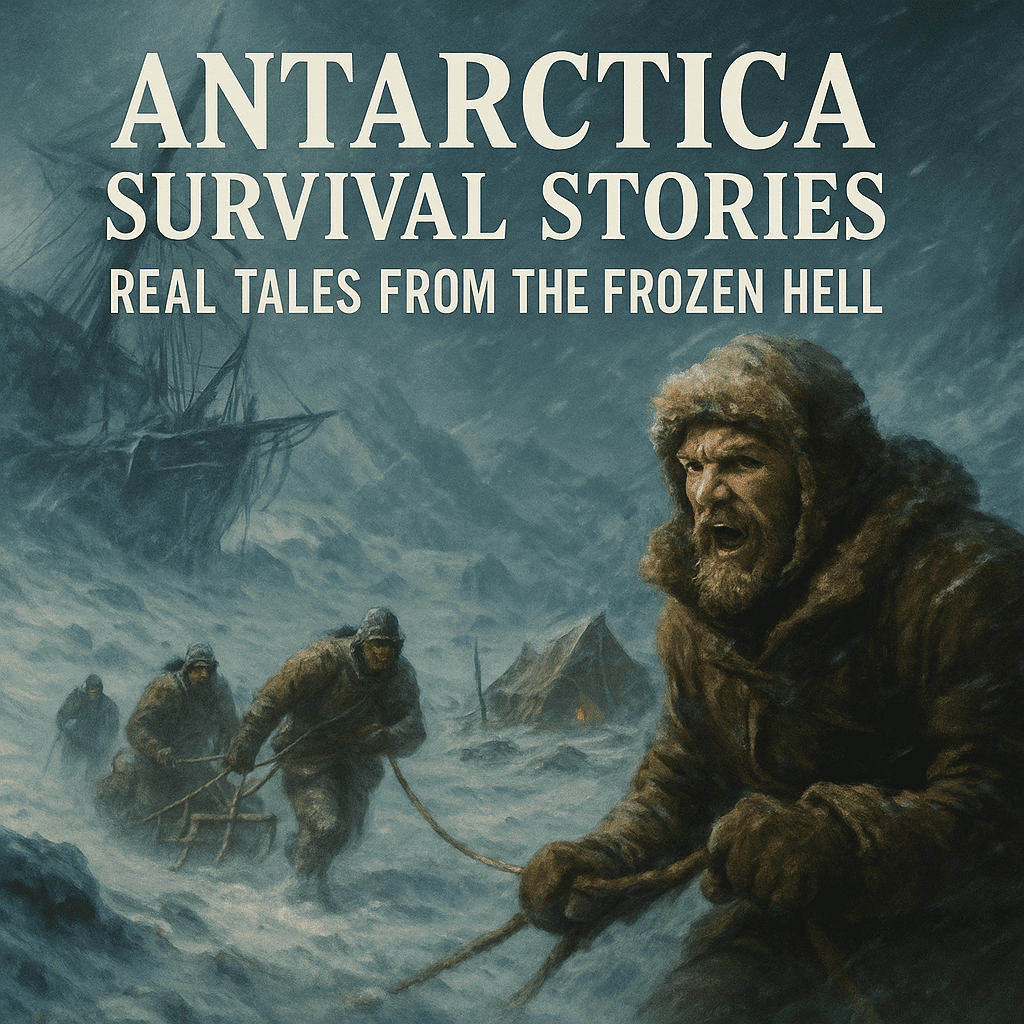
📍 Introduction Antarctica Survival Stories
Imagine standing on a land where the air slices through your skin, where the sun disappears for months, and where silence is broken only by howling winds. That’s Antarctica — beautiful yet brutal. It’s not just the cold that kills. It’s isolation. It’s starvation. It’s madness.
This isn’t fiction. These are the real stories of men who entered Antarctica and faced hell — not made of fire, but of ice.
🧭 Chapter 1: Shackleton’s Hell – The Miracle of Endurance (1914–1917)
In 1914, Sir Ernest Shackleton and his 27-man crew sailed on the Endurance to cross Antarctica. But fate had other plans.
Their ship was crushed by sea ice, leaving them stranded with no land, no help, and no way out. Temperatures dropped below –40°C. Their food ran out. They ate seal meat and eventually their sled dogs.
For 497 days, these men drifted on ice floes, praying for a miracle. Shackleton finally sailed 800 miles in a tiny lifeboat across stormy seas to get help.
🧠 What makes this story unforgettable?
No one died. Not a single man.
But they came back changed — some mentally broken, others never spoke of it again.
“We had seen God in His splendors, heard the text that Nature renders. We had reached the naked soul of man.” – Shackleton
🌑 Chapter 2: The Belgica and the Madness of the Polar Night (1897–1899)
Long before Shackleton, Belgian explorer Adrien de Gerlache led the Belgica deep into Antarctica. Their ship got trapped in ice — and they became the first humans ever to face an Antarctic winter.
What followed was pure nightmare.
-
The sun vanished for months.
-
Men began to hallucinate and turn violent.
-
Scurvy turned their gums black and their skin yellow.
-
Some tried to kill themselves. One even begged to be left outside to freeze.
Only through risky surgeries, makeshift lamps, and extreme courage did they survive. But most were never the same again.
Keyword: polar madness, antarctic expedition disasters
❄️ Chapter 3: The Death March of Captain Scott (1910–1913)
Captain Robert Falcon Scott had a dream: to be the first man to reach the South Pole. He and his team made it… only to find a Norwegian flag already there. Roald Amundsen had beaten them by a month.
Crushed and exhausted, they began their journey back. It was the beginning of the end.
-
Their supplies dwindled.
-
Frostbite ate away their fingers and toes.
-
They were caught in a blizzard — and couldn’t move.
The final entry in Scott’s diary is haunting:
“We shall stick it out to the end… but we are getting weaker, of course, and the end cannot be far. It seems a pity, but I do not think I can write more.”
They died 11 miles from safety. Frozen in their tents. History would call them heroes — but they died broken and you also read this.
🌨️ Chapter 4: The Silent Graves of the Forgotten
While Shackleton and Scott became legends, dozens of lesser-known expeditions disappeared without a headline.
-
Crews from Norway and Russia vanished into the white abyss.
-
Whalers froze in their cabins with no fuel.
-
Scientists were swallowed by crevasses, never to be found again.
Journals recovered years later revealed the horror:
“The cold is in my bones. I no longer feel my hands. I dream of home, but I know I won’t see it again.”
These are the nameless victims of the Antarctic hell, buried beneath centuries of snow.
🌋 Chapter 5: Fire Beneath Ice – The Mount Erebus Paradox
Mount Erebus, Antarctica’s active volcano, is a rare and terrifying phenomenon. Beneath the frozen sky, it spews molten lava.
Now imagine being a researcher near its summit, standing between subzero blizzards and boiling magma.
In 1979, an Air New Zealand sightseeing plane crashed into Erebus due to whiteout conditions, killing all 257 people on board.
Antarctica’s hell isn’t just frozen — sometimes, it burns.
🧠 Why Is Antarctica So Deadly?
-
Temperatures: As low as –89°C (–128°F)
-
Isolation: No native humans, no easy rescue
-
Weather: Sudden storms, 100+ km/h winds
-
Mental toll: 6 months of darkness = hallucinations, depression
-
No forgiveness: One mistake can mean death
Even modern scientists stationed there undergo psychological evaluations and strict survival training.
📌 Final Reflections: Hell Isn’t Always Hot
Antarctica isn’t just a place — it’s a test. A test of body, mind, and spirit.
These explorers weren’t chasing fame. They were chasing something deeper: purpose, discovery, and legacy. But many paid the price.
So, the next time you wrap yourself in a warm blanket, think of those who slept in snow-covered tents, praying the night wouldn’t be their last.
They faced the real frozen hell of Earth — and some lived to tell the tale.












Sodiceram: Exploring the World of Advanced Ceramic Innovation - Space Coast Daily UK
[…] Read another post: Antarctica Survival Stories […]