
For More News And info: Space Coast Daily Uk,
AI & Innovation
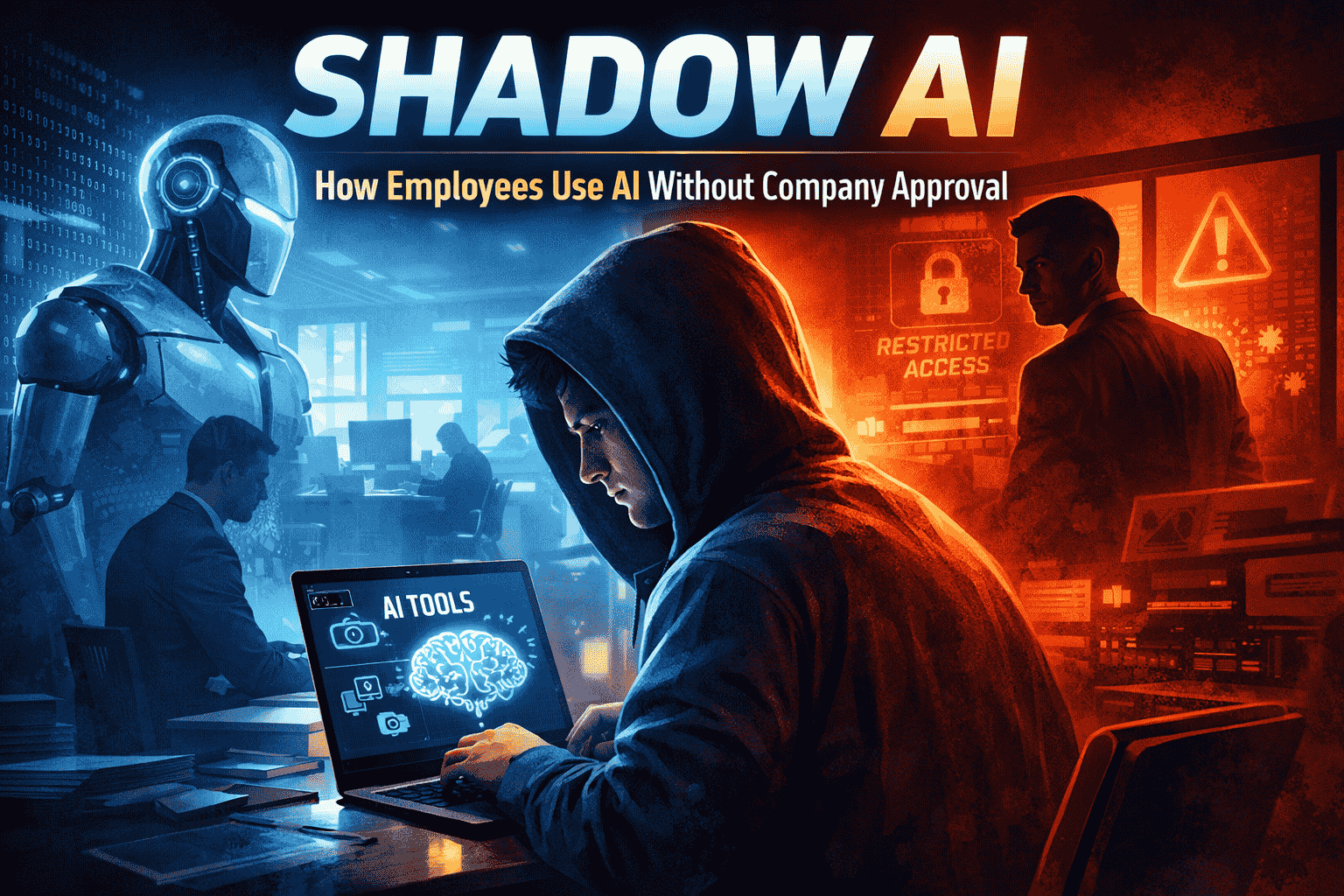
What Is Shadow AI? How Employees Use AI Without Company Approval

Introduction
Artificial Intelligence (AI) has rapidly transformed how modern workplaces operate. From drafting emails to analyzing data, AI tools promise speed, efficiency, and smarter decision-making. However, a new and largely hidden trend is quietly growing inside organizations worldwide Shadow AI.
Shadow AI refers to the use of AI tools by employees without official company approval or oversight. While often well-intentioned, this invisible adoption of AI presents serious risks related to data security, compliance, ethics, and organizational trust.
In this article, we will explore what Shadow AI is, why employees are using it secretly, real-world examples, risks for businesses, and how organizations can respond responsibly.
What Is Shadow AI?
Shadow AI is the unauthorized use of artificial intelligence tools, platforms, or services by employees within a company environment.
These tools are often:
-
Public AI chatbots
-
AI writing assistants
-
Image or video generators
-
Data analysis tools
-
Code-generation platforms
Employees may use them to complete tasks faster without informing IT departments, managers, or compliance teams.
Shadow AI is similar to “Shadow IT,” but with much higher risks because AI systems can process, store, and learn from sensitive data.
Why Employees Use Shadow AI Without Approval
Despite corporate policies, employees increasingly turn to AI tools on their own. Here’s why:
1. Pressure to Be More Productive
Workplaces are more demanding than ever. Employees feel pressure to:
-
Meet tight deadlines
-
Produce higher output
-
Compete with AI-powered colleagues
AI tools offer instant assistance making them tempting shortcuts.
2. Slow Corporate AI Adoption
Many companies take months (or years) to approve new technologies due to:
-
Security reviews
-
Legal concerns
-
Budget approvals
Employees don’t want to wait so they act independently.
3. Ease of Access
Most AI tools require:
-
No installation
-
No company credentials
-
Just a browser and internet
This low barrier encourages silent adoption.
4. Lack of Clear AI Policies
In many organizations:
-
AI policies don’t exist
-
Or are vague and outdated
Employees assume “if it’s not forbidden, it’s allowed.”
Common Examples of Shadow AI in the Workplace
Shadow AI is more common than most companies realize. Typical examples include:
-
Using AI chatbots to summarize confidential documents
-
Uploading internal data to AI tools for analysis
-
Generating client emails or proposals using public AI platforms
-
Using AI to write code that integrates with company systems
-
Creating marketing content using AI tools without brand review
These actions often happen daily unnoticed.
The Hidden Risks of Shadow AI
While Shadow AI may improve short-term productivity, it introduces serious long-term risks.
1. Data Security & Privacy Risks
Many AI tools:
-
Store user inputs
-
Train future models on submitted data
-
Operate outside company-controlled servers
This means sensitive data such as:
-
Client information
-
Financial records
-
Internal strategies
could be exposed or misused.
2. Compliance & Legal Issues
Shadow AI can violate:
-
GDPR (UK/EU)
-
Data protection laws
-
Industry regulations
Even if an employee acts independently, the company remains legally responsible.
3. Loss of Intellectual Property
Employees may unknowingly feed:
-
Trade secrets
-
Proprietary methods
-
Confidential algorithms
into third-party AI systems permanently losing ownership.
4. Inaccurate or Biased Outputs
AI tools can:
-
Generate false information
-
Reflect bias
-
Hallucinate facts
Without oversight, bad outputs can damage:
-
Brand reputation
-
Client trust
-
Business decisions
5. Ethical & Trust Concerns
Shadow AI erodes:
-
Transparency
-
Accountability
-
Trust between employees and leadership
It creates a culture of secrecy instead of innovation.
Why Shadow AI Is Growing So Fast
Shadow AI isn’t slowing down it’s accelerating.
Key reasons include:
-
Explosion of free AI tools
-
Remote and hybrid work models
-
Rising competition and automation fears
-
Employees wanting to stay relevant
Many workers see AI as a survival tool, not a threat.
Shadow AI vs Approved Enterprise AI
| Feature | Shadow AI | Approved AI |
|---|---|---|
| Approval | No | Yes |
| Oversight | None | Full governance |
| Data Control | External | Internal |
| Compliance | Risky | Audited |
| Security | Unknown | Enforced |
Shadow AI fills a gap but unsafely.
How Companies Can Address Shadow AI (Without Banning It)
Banning AI completely is unrealistic. Smart organizations focus on control, education, and trust.
1. Create Clear AI Usage Policies
Policies should clearly define:
-
Allowed tools
-
Prohibited uses
-
Data handling rules
Clarity reduces risky behavior.
2. Provide Approved AI Alternatives
If employees need AI:
-
Offer secure, internal AI tools
-
Integrate AI into workflows
People use Shadow AI when no safe option exists.
3. Educate Employees
Training should explain:
-
AI risks
-
Data privacy concerns
-
Responsible AI usage
Education works better than punishment.
4. Encourage Transparency
Create a culture where employees feel safe to:
-
Suggest AI tools
-
Report usage
-
Collaborate on innovation
5. Monitor Without Micromanaging
Use governance frameworks not surveillance to:
-
Track AI adoption trends
-
Identify risks early
Is Shadow AI Always Bad?
Not entirely.
Shadow AI highlights:
-
Innovation gaps
-
Employee needs
-
Inefficient systems
If managed correctly, Shadow AI can become a signal — not a threat.
The Future of Shadow AI
As AI becomes more powerful:
-
Shadow AI will increase
-
Regulation will tighten
-
Companies must adapt quickly
Organizations that embrace responsible AI adoption will outperform those that ignore or fear it.
Final Thoughts
Shadow AI is no longer a fringe issue it’s a mainstream workplace reality.
Employees are already using AI. The real question is whether companies will:
-
Fight it blindly
-
Or guide it intelligently
The future belongs to organizations that balance innovation, security, and trust without driving AI usage underground.
More intresting Posts
Is Janitor AI Safe to Use? (Privacy & Risks Explained)
Continue Reading
AI & Innovation
UN Launches First-Ever Global AI Panel: How Artificial Intelligence is Reshaping Governance, Economy, and Society in 2026

Artificial intelligence has transitioned from technological curiosity to central organizing principle of global affairs, prompting the United Nations to establish its first-ever Independent International Scientific Panel on AI—a landmark initiative convening this week for its inaugural in-person summit. This development signals recognition that AI governance can no longer remain fragmented among national regulators and corporate self-policing, but requires coordinated international frameworks.
The UN AI Panel: Structure and Mandate
The Independent International Scientific Panel on AI represents the first global body of its kind, bringing together leading researchers, policymakers, and ethicists from diverse national and disciplinary backgrounds. Unlike previous AI governance initiatives focused on specific applications or regional markets, this panel possesses a comprehensive mandate to assess AI’s global impact across economic, social, security, and environmental dimensions.
The panel’s inaugural summit, held April 11, 2026, establishes working groups addressing:
-
Economic transformation and labor market impacts
-
Security applications including autonomous weapons and cyber defense
-
Environmental consequences of AI infrastructure expansion
-
Democratic governance and information ecosystem integrity
-
Development applications for emerging economies
This structure reflects recognition that AI impacts are interconnected and require holistic rather than siloed policy responses. The panel’s findings will inform both national regulatory frameworks and international agreements, potentially establishing baseline standards for responsible AI development.
Economic Transformation: The Productivity Imperative
Business leaders entering 2026 face unprecedented pressure to demonstrate concrete returns on AI investments. After years of experimental deployment and anecdotal efficiency gains, boards and CFOs are demanding measurable impact on growth and competitiveness. This “show me the money” moment represents a critical inflection point in AI adoption.
Organizations are responding by shifting from general-purpose AI tools to specialized “agentic AI” systems capable of autonomous action across business functions. These systems are transforming:
-
Customer service through intelligent automation that resolves complex inquiries without human intervention
-
Supply chain management via predictive analytics that anticipate disruptions before they materialize
-
Financial operations through automated compliance monitoring and risk assessment
-
Research and development using AI-accelerated discovery processes
However, hiring trends reveal a more complex picture than simple substitution narratives suggest. Growth in some white-collar sectors is slowing as organizations redistribute tasks to digital systems, yet entirely new occupational categories are emerging around AI supervision, prompt engineering, and human-machine collaboration design. The net employment impact remains uncertain, though structural dislocation is clearly occurring.
The Future of Work: An Agentic Landscape
The integration of agentic AI—systems capable of autonomous decision-making and action—is forcing fundamental reconsideration of workforce organization. Traditional employment models assumed human judgment at critical decision points; agentic systems challenge this assumption by demonstrating capability to manage complex workflows with minimal supervision.
Key developments include:
-
Task fragmentation as AI handles routine cognitive work while humans focus on exception management and relationship maintenance
-
Skills polarization between high-value creative and strategic roles versus declining demand for routine analytical positions
-
Geographic redistribution of work as AI-enabled remote collaboration reduces location advantages previously concentrated in major metropolitan areas
-
Regulatory lag as legal frameworks struggle to address accountability, liability, and cybersecurity implications of autonomous systems
Leaders in 2026 must navigate both technological and regulatory disruption, developing workforce strategies that anticipate rather than react to these structural shifts.
Geopolitical AI Competition: The Sovereign Technology Race
Nations worldwide are pursuing “sovereign AI” strategies to ensure economic security and reduce dependence on foreign technology providers. This trend reflects concerns about:
-
Data sovereignty and protection of sensitive national information
-
Supply chain security for critical AI infrastructure including semiconductors and cloud computing
-
Strategic autonomy in applications affecting national security and economic competitiveness
-
Cultural alignment ensuring AI systems reflect local values and linguistic diversity
The United States maintains leadership in foundational AI research and leading commercial platforms, but faces challenges from concentrated chip manufacturing and growing Chinese capabilities. China has demonstrated remarkable progress in AI applications despite technology access restrictions, raising questions about whether export controls can maintain competitive advantages. Meanwhile, the European Union has prioritized regulatory leadership through comprehensive AI governance frameworks that may influence global standards.
This three-way competition—American innovation, Chinese scale, European regulation—defines the geopolitical AI landscape in 2026, with significant implications for businesses operating across jurisdictions.
Education in Transformation: The Curriculum Crisis
AI integration into professional and daily life has exposed widening gaps between educational curricula and workplace requirements. Traditional credentialing systems struggle to signal relevant competencies in rapidly evolving fields, while employers increasingly prioritize demonstrated skills over formal qualifications.
Innovative responses include:
-
Industry-academic partnerships creating responsive curriculum updates
-
Micro-credentialing systems certifying specific skill sets with shorter refresh cycles
-
AI-enhanced personalized learning adapting to individual student needs and pacing
-
Lifelong learning infrastructure supporting continuous reskilling throughout careers
The trust erosion between educational institutions and employers threatens to destabilize social mobility mechanisms that have underpinned democratic societies. Rebuilding this trust through demonstrable outcome improvements represents a critical challenge for 2026.
Healthcare Revolution: The “Dr. Me” Phenomenon
Healthcare systems worldwide face capacity crises as aging populations and chronic disease burdens overwhelm traditional service delivery models. In the United Kingdom, the National Health Service maintains waiting lists exceeding 7.4 million patients. In Italy, obtaining GP callbacks requires weeks. In the United States, cost barriers limit access despite world-leading expenditures.
These failures have catalyzed what researchers term the “Dr. Me” phenomenon—consumers taking health management into their own hands through AI-assisted self-diagnosis and wellness optimization. Body-worn technology now monitors everything from heart rate variability to sleep architecture, while AI systems provide personalized recommendations previously available only through specialized medical consultation.
This trend raises profound questions about:
-
Medical liability when AI diagnoses prove incorrect
-
Health equity as affluent populations access superior self-care tools
-
System sustainability as formal healthcare loses its monopoly on health information
-
Regulatory frameworks for AI medical devices operating across jurisdictions
The quantified self, once a niche pursuit, is becoming mainstream, with implications for healthcare providers, insurers, and pharmaceutical companies.
Environmental Impact: The Data Center Dilemma
AI infrastructure expansion creates significant environmental pressures that challenge green transition commitments. Data centers powering AI applications consume enormous electricity and water resources, generating local political opposition in regions hosting major facilities.
Simultaneously, AI applications offer potential solutions for climate challenges:
-
Energy optimization through intelligent grid management
-
Climate modeling improving prediction accuracy and policy targeting
-
Material science accelerating development of sustainable alternatives
-
Agricultural efficiency through precision farming techniques
The net environmental impact of AI remains contested, with optimists emphasizing efficiency gains and pessimists highlighting infrastructure expansion emissions. This debate will intensify as AI deployment scales and environmental accounting methodologies mature.
Security Implications: Cyber-AI Arms Race
Cybersecurity and AI have become inseparable concerns as malicious actors deploy increasingly sophisticated automated attacks. State-linked hacking and cybercrime are now treated as inevitable threats, forcing organizations to prioritize resilience over prevention alone.
Critical security dimensions include:
-
AI-enabled attack automation scaling threat actor capabilities
-
Deepfake proliferation undermining identity verification and information integrity
-
Autonomous weapon systems raising unprecedented ethical and legal questions
-
Critical infrastructure vulnerability to AI-enhanced disruption
The cybersecurity debate now intersects with AI risk discussions, creating complex policy environments where technological and security governance cannot be separated.
Conclusion: Governance at the Crossroads
The UN AI Panel’s establishment represents acknowledgment that artificial intelligence has outgrown fragmented governance approaches. The choices made in 2026—regarding data sovereignty, algorithmic accountability, labor market adaptation, and security frameworks—will determine whether AI develops as a democratizing force or concentrates power in unprecedented ways.
For businesses, the imperative is clear: demonstrate concrete value from AI investments while building governance capabilities that anticipate regulatory evolution. For policymakers, the challenge involves enabling innovation while protecting public interests in an environment of rapid technological change. For citizens, the question is whether emerging governance frameworks will preserve human agency and dignity in an increasingly automated world.
The coming year will prove decisive in determining AI’s developmental trajectory for decades to come.
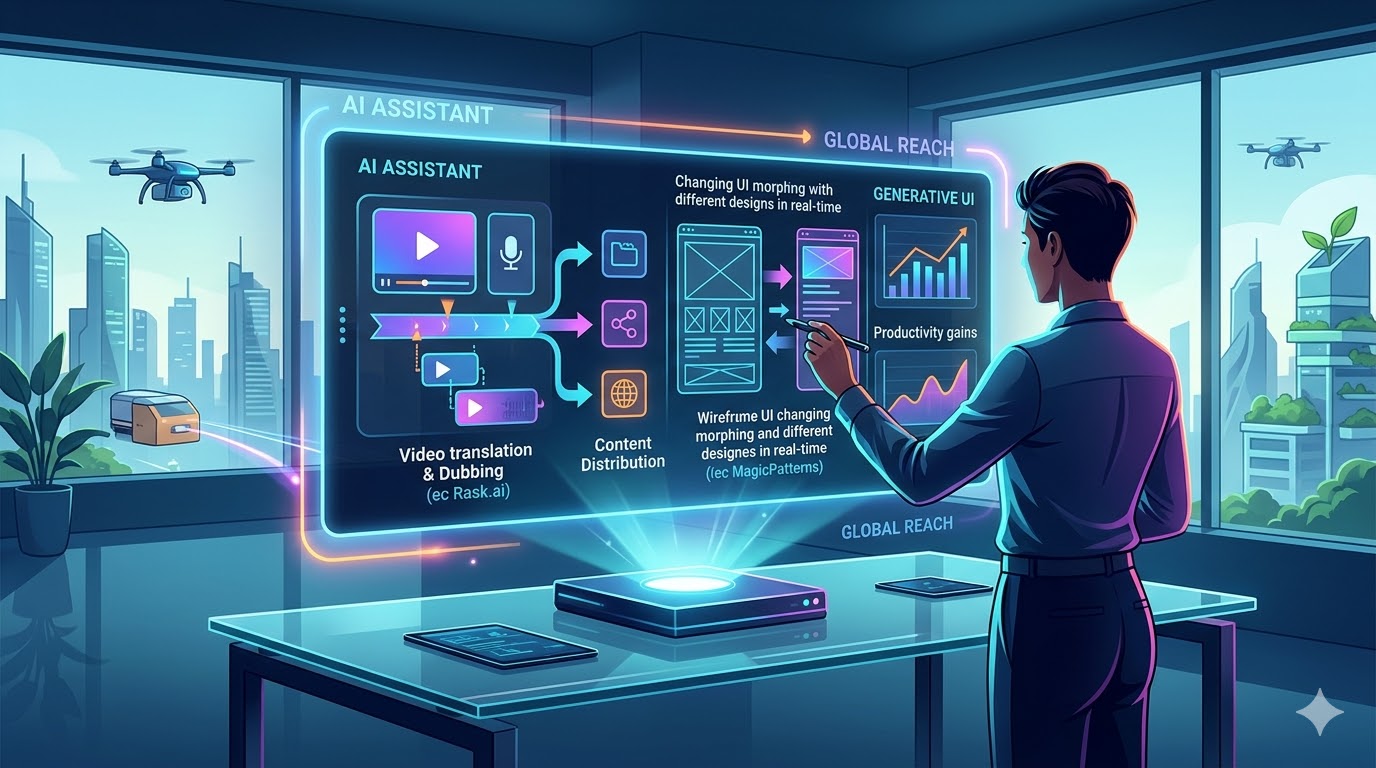
The digital landscape is shifting at an unprecedented pace. Just a few years ago, artificial intelligence was a niche interest for data scientists; today, it is the backbone of modern content creation and business operations. From generating high-fidelity images to automating complex coding tasks, the barrier to entry for creators has never been lower. However, with the market flooded with new “AI-powered” solutions every day, the real challenge has shifted from access to discernment.
Navigating the AI Tool Explosion
For professionals and enthusiasts alike, finding tools that actually deliver ROI—rather than just being a temporary gimmick—is crucial. This is where dedicated platforms like AICritic play a vital role. By providing deep-dive evaluations and hands-on testing, such resources help users cut through the marketing noise and identify software that truly enhances their specific workflows.
Video Localization and Prototyping: The New Frontiers
Two areas where AI has made massive leaps are video dubbing and UI/UX design.
-
Breaking Language Barriers: Global reach is no longer reserved for giant media houses. Tools like Rask.ai have revolutionized how we think about content distribution. If you are looking to scale your YouTube channel or corporate training globally, checking out a comprehensive Rask.ai Review can show you how AI-driven voice cloning and translation are saving creators thousands of dollars in dubbing costs.
-
Rapid Prototyping: For designers, the “blank canvas” problem is being solved by generative UI. Instead of spending days on initial wireframes, modern tools allow you to describe a component and see it manifest instantly. For instance, an in-depth MagicPatterns Review reveals how these tools are bridging the gap between a rough idea and a functional prototype in record time.
Conclusion
As we move further into 2026, the competitive advantage will belong to those who can effectively curate their “AI Stack.” Whether you are a solo creator or a growing tech firm, staying updated with honest, technical reviews is the only way to ensure your tech stack remains an asset rather than a distraction.
Introduction: The Age of Endless Scrolling
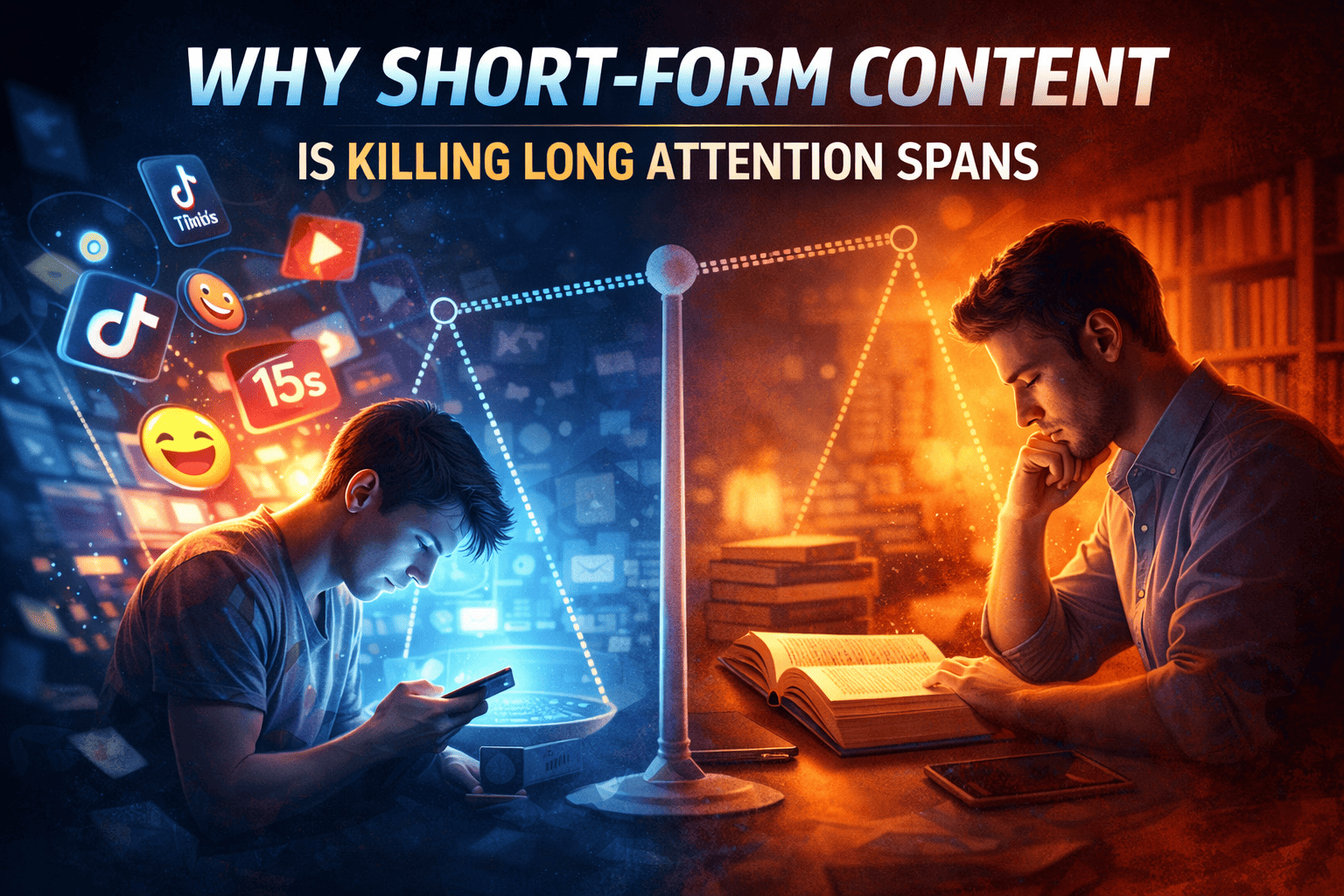
Modern digital life is dominated by short-form content. From 15-second videos to bite-sized posts, people now consume information faster than ever before. At first glance, this shift seems harmless even efficient. But beneath the surface, a deeper issue is emerging: our ability to focus for extended periods is quietly eroding.
This is not about blaming platforms or creators alone. It’s about understanding how continuous exposure to rapid, fragmented content is reshaping the human brain, attention patterns, and the way we think, learn, and make decisions.
The Rise of Short-Form Content
Short-form content didn’t rise by accident. It was designed for:
-
Speed
-
Convenience
-
Instant gratification
Algorithms prioritize content that:
-
Hooks users quickly
-
Requires minimal effort
-
Delivers fast emotional responses
As a result, long-form reading, deep thinking, and sustained focus are slowly being replaced by constant stimulation.
Attention Is Not Infinite It’s Trainable
Attention span is often misunderstood as a fixed trait. In reality, it’s a skill shaped by habits.
When people repeatedly consume:
-
Ultra-short videos
-
Rapid topic switching
-
Endless feeds
the brain adapts by expecting constant novelty. Anything requiring patience long articles, books, complex discussions — begins to feel exhausting.
This isn’t laziness. It’s conditioning.
How Short-Form Content Rewires the Brain
Neuroscience suggests that frequent exposure to quick-reward content trains the brain to:
-
Seek immediate stimulation
-
Avoid cognitive effort
-
Lose tolerance for boredom
Boredom, once a gateway to creativity and deep thought, is now treated as something to escape instantly — often with a swipe.
Over time, this creates a loop:
-
Reduced focus
-
Faster distraction
-
Even shorter content consumption
The Illusion of Productivity
Short-form content often feels productive. You consume more pieces of information in less time. But quantity is not the same as comprehension.
Many users:
-
Watch dozens of videos
-
Scroll for hours
-
Retain very little
This creates information saturation without understanding a state where people feel informed but struggle to recall, analyze, or apply what they’ve seen.
What Happens to Deep Thinking?
Deep thinking requires:
-
Time
-
Silence
-
Mental continuity
Short-form content disrupts all three.
When attention is constantly interrupted:
-
Complex ideas feel overwhelming
-
Long arguments lose appeal
-
Nuanced thinking declines
This affects not only reading habits, but also:
-
Problem-solving
-
Decision-making
-
Emotional regulation
The Impact on Learning and Memory
Learning thrives on repetition, reflection, and sustained focus. Short-form content encourages the opposite:
-
Jumping between topics
-
Surface-level exposure
-
Minimal reflection
As a result:
-
Memory retention weakens
-
Conceptual understanding declines
-
Learning becomes fragmented
This is especially concerning for students and young professionals who rely on cognitive endurance to grow.
Short Content vs Long Content: A False War
The issue is not that short-form content exists it’s that it dominates.
Short content can:
-
Introduce ideas
-
Spark curiosity
-
Entertain
But it was never meant to replace:
-
Long reading
-
In-depth discussion
-
Sustained engagement
When short content becomes the default, depth becomes optional and eventually rare.
Why Long Attention Spans Still Matter
Long attention spans enable:
-
Critical thinking
-
Emotional intelligence
-
Creativity
-
Strategic planning
Societies that lose the ability to focus deeply risk becoming:
-
Reactive instead of reflective
-
Emotion-driven rather than reason-driven
In such environments, complexity is avoided, and oversimplification thrives.
Are Platforms to Blame?
Blaming platforms alone misses the point.
Platforms respond to:
-
User behavior
-
Engagement patterns
-
Market incentives
The real issue is unconscious consumption users rarely pause to question how content is shaping them.
Awareness is the first step toward balance.
Rebuilding Attention in a Short-Content World
Recovering long attention spans doesn’t require abandoning digital platforms. It requires intentional use.
Simple but effective practices include:
-
Reading long articles without multitasking
-
Watching fewer but more meaningful videos
-
Allowing moments of boredom
-
Practicing deep work sessions
Attention improves when it is exercised just like a muscle.
The Future of Content Consumption
The future will not eliminate short-form content. But there is growing demand for:
-
Depth over speed
-
Meaning over virality
-
Quality over quantity
Creators and platforms that support thoughtful engagement will stand out in a world overwhelmed by noise.
Final Thoughts: Choosing Depth in a Shallow Stream
Short-form content is not inherently harmful. But unchecked consumption is.
The quiet erosion of attention spans is one of the most overlooked challenges of the digital age. Recognizing it allows individuals, educators, and creators to restore balance choosing depth when it matters most.
In a world that moves fast, the ability to slow down and think deeply may become the most valuable skill of all.
-
 news1 day ago
UK Housing Crisis Deepens: How London’s Affordability Crisis is Costing the Economy £7 Billion and Shaping the 2026 Political Landscape
-
AI & Innovation1 day ago
UN Launches First-Ever Global AI Panel: How Artificial Intelligence is Reshaping Governance, Economy, and Society in 2026
-
 news1 day ago
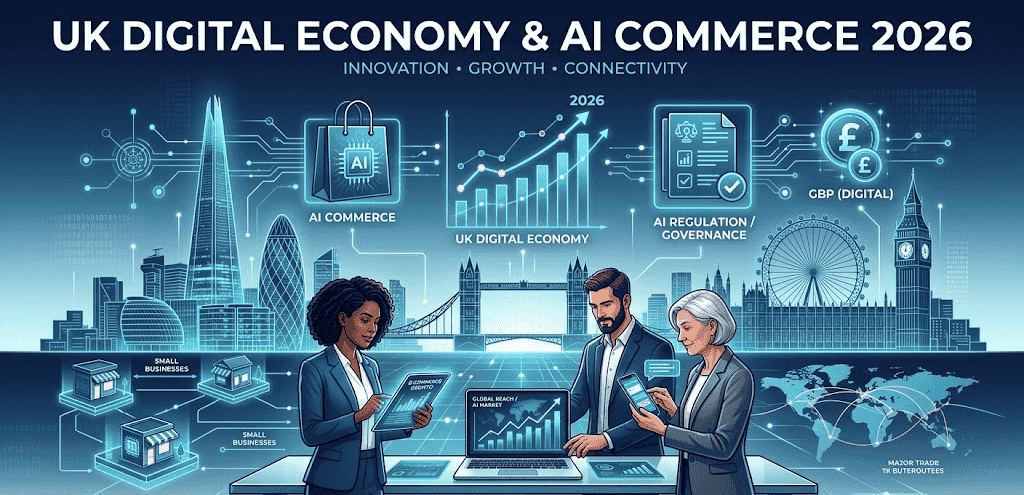
UK Digital Economy Transformation: How AI and New Regulations Are Reshaping British Commerce in 2026
-
 news2 weeks ago
The Iran-Israel Military Confrontation of 2026: A Comprehensive Strategic Analysis