

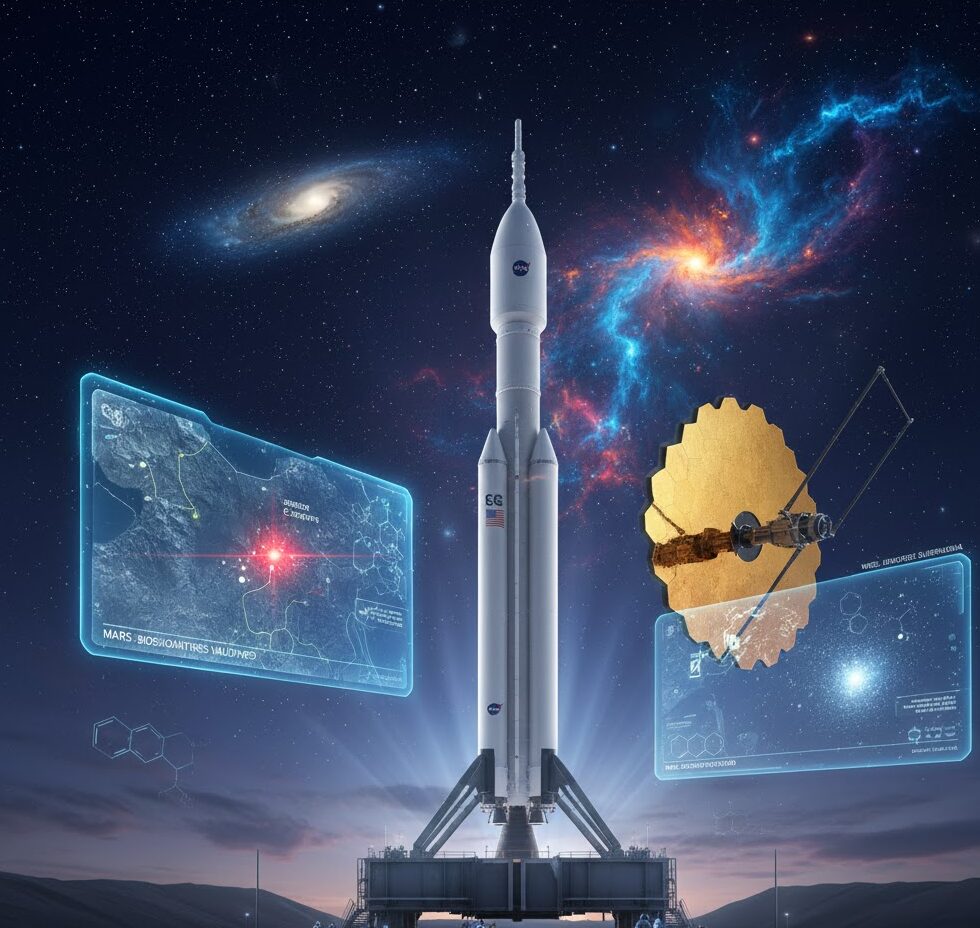
The year 2025 has been a monumental chapter in the history of space exploration. As we reach the end of the year, NASA is standing at the precipice of a “New Golden Age.” From the final assembly of the rocket that will carry humans back to the Moon to the discovery of potential life-signs on the Red Planet, the updates from December 2025 are nothing short of extraordinary.
In this detailed update, we dive deep into the current status of the Artemis Program, the mind-bending discoveries of the James Webb Space Telescope, and what the future holds for NASA under a changing political and budgetary landscape.
1. Artemis II: The Countdown to Lunar History Begins
The most significant breaking news at the end of 2025 is the successful stacking and integration of the Artemis II mission components. For the first time since the Apollo era, a crewed spacecraft is fully assembled and ready for its final journey to the Moon’s vicinity.
The Mission Specs
-
Launch Date: Targeted for early 2026 (No earlier than February–April).
-
The Crew: Reid Wiseman (Commander), Victor Glover (Pilot), Christina Koch (Mission Specialist), and Jeremy Hansen (Mission Specialist).
-
Duration: A 10-day high-stakes flight test.
Final Preparations in December 2025
As of mid-December, NASA engineers at the Kennedy Space Center have completed the integration of the Orion spacecraft with the Space Launch System (SLS) rocket. The crew has recently participated in over 30 intensive mission simulations, including emergency egress drills and communication tests using the new Optical Communications System (O2O), which will allow for high-definition video streaming from the Moon.
2. Breaking Discovery: Life on Mars?
While humans prepare to leave Earth, our robotic explorers are making history on Mars. In late 2025, NASA’s Perseverance Rover mission released data that has sent shockwaves through the scientific community.
The “Sapphire Canyon” Breakthrough
After a rigorous year-long peer-review process, the journal Nature has validated that the rock samples collected from the “Sapphire Canyon” region contain potential biosignatures.
-
What was found? Specific organic molecules and mineral patterns (like vivianite and greigite) that, on Earth, are almost exclusively created by microbial life.
-
The Verdict: While not yet “definitive proof,” scientists state this is the closest we have ever come to confirming that Mars once hosted life.
3. James Webb Space Telescope (JWST): Piercing the Dark Ages
The James Webb Space Telescope continues to rewrite our physics textbooks. In December 2025, JWST achieved two record-breaking milestones:
The Earliest Supernova
On December 9, 2025, NASA confirmed that Webb identified the earliest supernova to date. The star exploded when the universe was only 730 million years old. This discovery provides crucial data on how the first generation of stars died and seeded the universe with heavy elements.
Supermassive Black Hole Mysteries
Webb also confirmed an actively growing supermassive black hole just 570 million years after the Big Bang. This challenges existing theories because, according to current models, black holes shouldn’t have been able to grow that large that quickly.
4. The Budget Crisis and Mission Cancellations
Despite the scientific success, the end of 2025 brings significant challenges. The proposed 2026 NASA Budget suggests a massive 24% to 47% cut to science programs.
Impact on Future Missions:
-
Mars Sample Return (MSR): This mission, designed to bring Perseverance’s “life-containing” rocks back to Earth, is currently under threat of cancellation or major delay.
-
VIPER Rover: While initially canceled, a late 2025 deal with Blue Origin has given the Moon-water-scout a new lease on life, with a launch now planned for 2027.
-
Venus Missions: Projects like DaVinci and Veritas are facing indefinite delays as NASA prioritizes the Artemis Moon landings.
5. Summary Table: Mission Status as of December 2025
| Mission | Primary Objective | Current Status (Dec 2025) |
| Artemis II | Crewed Moon Flyby | Stacking Complete; Launch early 2026. |
| Perseverance | Mars Life Hunt | Validated potential biosignatures in Jezero Crater. |
| JWST | Deep Space Origins | Detected the universe’s earliest supernova (730m years post-Big Bang). |
| Europa Clipper | Jupiter Moon Study | Currently in deep-space cruise; 2026 Earth flyby next. |
| Artemis III | Human Moon Landing | Planned for 2027; Starship HLS development ongoing. |
6. What to Expect in 2026 and 2027
The next 24 months will be the most critical for NASA since 1969.
-
Artemis II Launch: If successful, it will prove that the SLS and Orion are safe for human life.
-
SpaceX Starship Progress: NASA is heavily dependent on Elon Musk’s SpaceX to provide the Human Landing System (HLS) for the Artemis III landing. 2026 will see critical “ship-to-ship” propellant transfer tests in orbit.
-
The New Space Race: With China aiming for a 2030 crewed landing, NASA is under immense pressure to meet its 2027-2029 landing goals.
Conclusion: A Pivot Point for Humanity
NASA’s mission updates at the end of 2025 show a tale of two realities: unparalleled scientific discovery and intense budgetary pressure. While the Webb telescope looks back to the beginning of time and Perseverance finds clues of ancient Martians, the focus of the world remains on the four astronauts preparing to board the SLS rocket.
Whether we land on the Moon in 2027 or 2029, one thing is certain: the journey has already begun, and there is no turning back.
NASA Ignites New Golden Age of Exploration This video is essential for your readers as it provides the official NASA briefing on the 2025 milestones and the upcoming Artemis II crewed flight.
Disclaimer: This article is based on the latest available data, mission reports, and official NASA announcements as of late 2025. Space exploration missions are subject to change due to technical, weather, or budgetary factors. Launch windows and mission timelines mentioned (such as Artemis II) are estimates provided by the agency and are not guaranteed. For real-time telemetry and official live updates, always refer to NASA’s official website.















Leave a Reply