

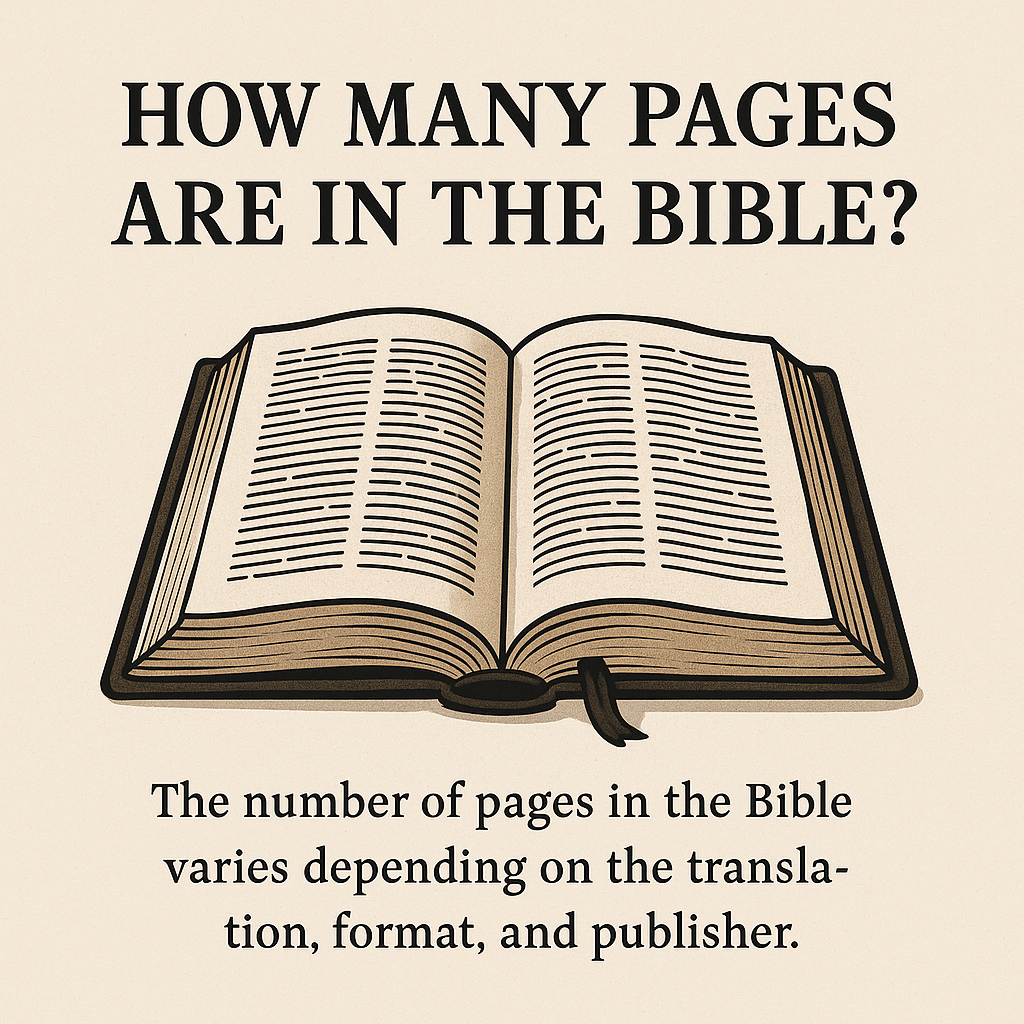
How Many Pages Are in the Bible?
The Bible is one of the most widely read and influential books in human history. It has been printed in countless editions, formats, and translations. If you’re wondering how many pages are in the Bible, the answer isn’t as straightforward as it might seem.
The number of pages varies depending on several key factors, which we’ll explore in this detailed guide.
Factors That Influence the Number of Pages
Several variables impact the total page count of a Bible:
- Translation Version: Different translations like the King James Version (KJV), New International Version (NIV), or English Standard Version (ESV) vary slightly in text length.
- Font Size and Type: Bibles with larger fonts (“large print” editions) will naturally have more pages.
- Page Layout: Some Bibles are printed in single-column format, while others use double columns, affecting page counts.
- Paper Thickness: Thin, high-quality paper (often called “Bible paper”) can pack more pages into a slimmer volume.
- Additional Content: Study Bibles often include footnotes, maps, commentaries, timelines, and appendices that add to the overall number of pages.
- Language: Some languages require more words or longer sentences to convey the same meaning, slightly affecting page counts.
Average Page Counts by Edition
To give you a clearer picture, here are average page counts for popular types of Bibles:
- Standard Print Bible (KJV, ESV, NIV): 1,000 to 1,500 pages
- Large Print Bible: 1,500 to 2,000 pages
- Study Bible: 2,000+ pages
- Pocket-Sized Bible: 700 to 1,000 pages
- Parallel Bible (Multiple Translations Side-by-Side): 2,000 to 3,000 pages
It’s important to note that the Bible is typically divided into two main sections:
- Old Testament: 39 books
- New Testament: 27 books
Together, they comprise 66 books in most Protestant traditions.
How Different Translations Compare
- King James Version (KJV): Typically around 1,200 pages
- New International Version (NIV): Approximately 1,300 pages
- English Standard Version (ESV): Around 1,240 pages
- New American Standard Bible (NASB): Roughly 1,400 pages
- Catholic Bible (Including Deuterocanonical Books): Approximately 1,500+ pages
Catholic Bibles, which include additional books called the “Deuterocanonical books,” usually have slightly more pages. Orthodox Bibles may contain even more books, adding additional pages.
Why Page Count Matters
Understanding the page count can help readers in various ways:
- Planning a Reading Schedule: Knowing the length helps in setting achievable daily reading goals.
- Selecting a Suitable Edition: For travel, study, or casual reading, page count can influence which Bible edition best fits your needs.
- Comparing Study Materials: Study Bibles are heavier and bulkier due to added content, which is crucial for in-depth learning.
- Budget Considerations: Larger, study-heavy Bibles often come at a higher price point.
How Long Does It Take to Read the Bible?
If you know the average number of pages, you can better plan a reading schedule. Here’s a basic breakdown:
- Daily Reading: Reading about 3-4 pages per day will help you finish the Bible in one year.
- 6-Month Plan: Reading 6-8 pages daily will allow you to complete the Bible in six months.
- 90-Day Plan: Reading about 12-14 pages daily will complete it in around three months.
Reading speeds, comprehension goals, and devotional practices can alter these numbers.
Special Editions and Their Page Counts
Some editions are designed for specific audiences and purposes, affecting page counts:
- Children’s Bibles: Often condensed with fewer pages (300-600 pages).
- Devotional Bibles: Includes daily devotionals, often pushing the page count to 1,800+.
- Chronological Bibles: Arranged in historical order; page counts vary around 1,500 pages.
- Illustrated Bibles: Include extensive artwork and imagery, often adding hundreds of pages.
Frequently Asked Questions (FAQs)
Q: Why do some Bibles have more pages than others? A: The variation is due to font size, margins, footnotes, paper thickness, language, and additional study content.
Q: How many words are in the Bible? A: In the King James Version, there are approximately 783,137 words.
Q: Can I read the entire Bible in a year? A: Absolutely. Reading about 3-4 pages daily can help you complete it within a year.
Q: Is the Bible longer in different languages? A: Slightly. Translation choices and language structures can cause minor differences in word count and page count.
Q: Are all Bibles organized the same way? A: Not always. Protestant, Catholic, and Orthodox Bibles have slightly different book arrangements and total book counts.
Q: Which Bible version is the shortest? A: Some paraphrased translations like The Message can be slightly shorter in word count compared to more literal translations like NASB or ESV.
Conclusion: Page Counts Vary, But the Message Remains
When asking how many pages are in the Bible, remember that the answer depends on the edition, print size, translation, and additional content. Whether your Bible has 1,000 or 2,000 pages, its core message of faith, hope, and salvation remains unchanged.
Choose a Bible edition that fits your lifestyle and reading habits. Whether for study, devotion, travel, or casual reading, the journey through its pages is truly life-changing. With careful planning, a commitment to daily reading, and a good understanding of your Bible’s structure, you can experience the full richness of this timeless text.











Leave a Reply