

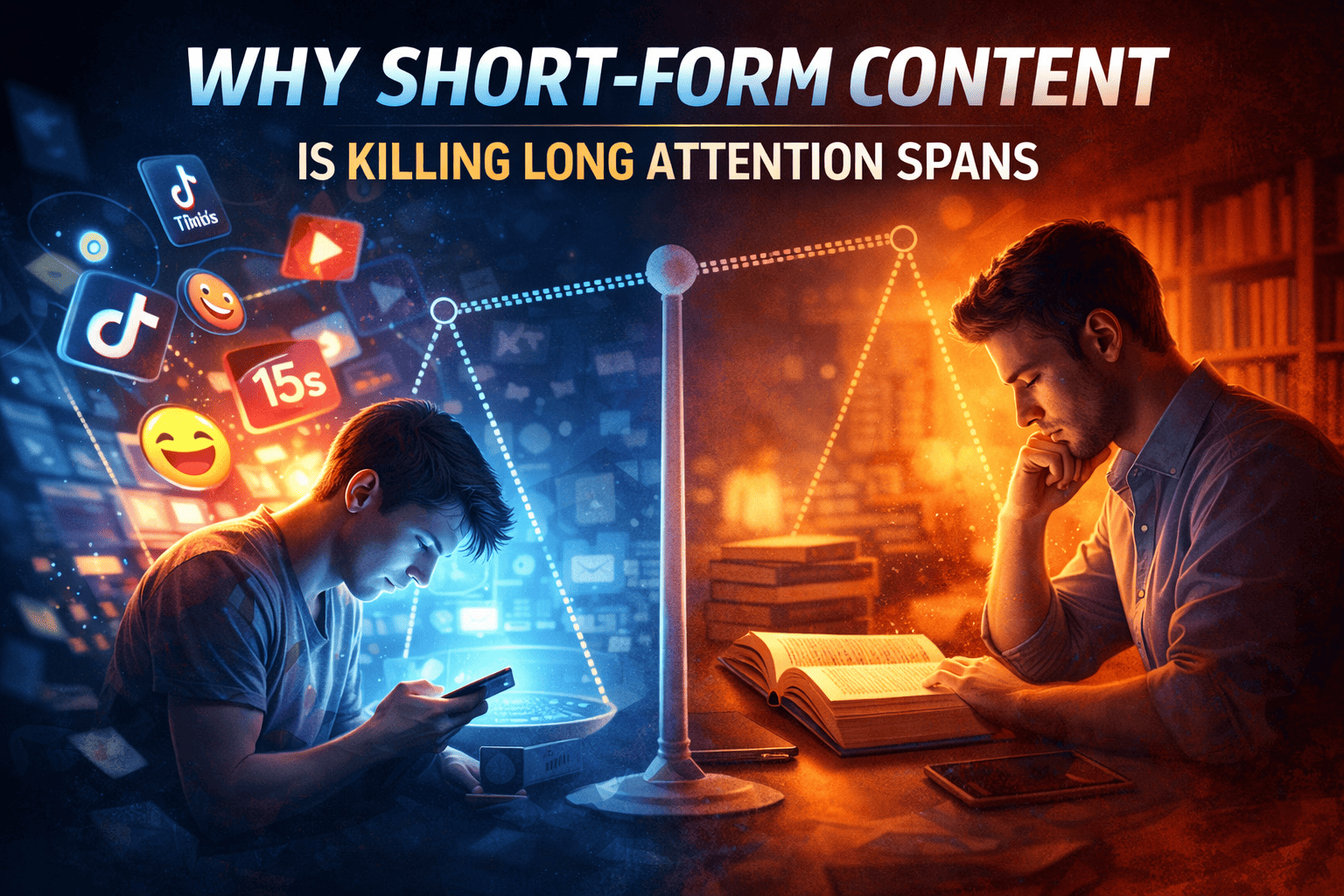
Introduction: The Age of Endless Scrolling
Modern digital life is dominated by short-form content. From 15-second videos to bite-sized posts, people now consume information faster than ever before. At first glance, this shift seems harmless even efficient. But beneath the surface, a deeper issue is emerging: our ability to focus for extended periods is quietly eroding.
This is not about blaming platforms or creators alone. It’s about understanding how continuous exposure to rapid, fragmented content is reshaping the human brain, attention patterns, and the way we think, learn, and make decisions.
The Rise of Short-Form Content
Short-form content didn’t rise by accident. It was designed for:
-
Speed
-
Convenience
-
Instant gratification
Algorithms prioritize content that:
-
Hooks users quickly
-
Requires minimal effort
-
Delivers fast emotional responses
As a result, long-form reading, deep thinking, and sustained focus are slowly being replaced by constant stimulation.
Attention Is Not Infinite It’s Trainable
Attention span is often misunderstood as a fixed trait. In reality, it’s a skill shaped by habits.
When people repeatedly consume:
-
Ultra-short videos
-
Rapid topic switching
-
Endless feeds
the brain adapts by expecting constant novelty. Anything requiring patience long articles, books, complex discussions — begins to feel exhausting.
This isn’t laziness. It’s conditioning.
How Short-Form Content Rewires the Brain
Neuroscience suggests that frequent exposure to quick-reward content trains the brain to:
-
Seek immediate stimulation
-
Avoid cognitive effort
-
Lose tolerance for boredom
Boredom, once a gateway to creativity and deep thought, is now treated as something to escape instantly — often with a swipe.
Over time, this creates a loop:
-
Reduced focus
-
Faster distraction
-
Even shorter content consumption
The Illusion of Productivity
Short-form content often feels productive. You consume more pieces of information in less time. But quantity is not the same as comprehension.
Many users:
-
Watch dozens of videos
-
Scroll for hours
-
Retain very little
This creates information saturation without understanding a state where people feel informed but struggle to recall, analyze, or apply what they’ve seen.
What Happens to Deep Thinking?
Deep thinking requires:
-
Time
-
Silence
-
Mental continuity
Short-form content disrupts all three.
When attention is constantly interrupted:
-
Complex ideas feel overwhelming
-
Long arguments lose appeal
-
Nuanced thinking declines
This affects not only reading habits, but also:
-
Problem-solving
-
Decision-making
-
Emotional regulation
The Impact on Learning and Memory
Learning thrives on repetition, reflection, and sustained focus. Short-form content encourages the opposite:
-
Jumping between topics
-
Surface-level exposure
-
Minimal reflection
As a result:
-
Memory retention weakens
-
Conceptual understanding declines
-
Learning becomes fragmented
This is especially concerning for students and young professionals who rely on cognitive endurance to grow.
Short Content vs Long Content: A False War
The issue is not that short-form content exists it’s that it dominates.
Short content can:
-
Introduce ideas
-
Spark curiosity
-
Entertain
But it was never meant to replace:
-
Long reading
-
In-depth discussion
-
Sustained engagement
When short content becomes the default, depth becomes optional and eventually rare.
Why Long Attention Spans Still Matter
Long attention spans enable:
-
Critical thinking
-
Emotional intelligence
-
Creativity
-
Strategic planning
Societies that lose the ability to focus deeply risk becoming:
-
Reactive instead of reflective
-
Emotion-driven rather than reason-driven
In such environments, complexity is avoided, and oversimplification thrives.
Are Platforms to Blame?
Blaming platforms alone misses the point.
Platforms respond to:
-
User behavior
-
Engagement patterns
-
Market incentives
The real issue is unconscious consumption users rarely pause to question how content is shaping them.
Awareness is the first step toward balance.
Rebuilding Attention in a Short-Content World
Recovering long attention spans doesn’t require abandoning digital platforms. It requires intentional use.
Simple but effective practices include:
-
Reading long articles without multitasking
-
Watching fewer but more meaningful videos
-
Allowing moments of boredom
-
Practicing deep work sessions
Attention improves when it is exercised just like a muscle.
The Future of Content Consumption
The future will not eliminate short-form content. But there is growing demand for:
-
Depth over speed
-
Meaning over virality
-
Quality over quantity
Creators and platforms that support thoughtful engagement will stand out in a world overwhelmed by noise.
Final Thoughts: Choosing Depth in a Shallow Stream
Short-form content is not inherently harmful. But unchecked consumption is.
The quiet erosion of attention spans is one of the most overlooked challenges of the digital age. Recognizing it allows individuals, educators, and creators to restore balance choosing depth when it matters most.
In a world that moves fast, the ability to slow down and think deeply may become the most valuable skill of all.




Leave a Reply